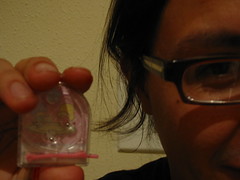
Nothingness encapsulated. You won't feel a thing.
Saturday, November 27, 2004
Wednesday, November 24, 2004
Light and day is more than you'll say
Because all
My feelings are more
Than i can let by
Or not
More than you've got
Just follow the day
Follow the day and reach for the sun!
You don't see me flyin to the red
One more you're done
Just follow the seasons and find the time
Reach for the bright side
You don't see me flyin to the red
One more you're nuts
Just follow the day
Follow the day and reach for the sun
Just follow the day
Follow the day and reach for the sun!
Tuesday, November 09, 2004
Geometry is a large subfield of mathematics, but also a label for a certain mindset of a practising mathematician. The same can be told about Algebra (understood here broadly, as the language of mathematics, as opposed to its content, and so including Logic.) A natural or acquired predilection towards geometric or algebraic thinking and respective mental objects is often expressed in strong pronouncements, like Hermann Weyl's exorcising "the devil of abstract algebra" who allegedly struggles with "the angel of geometry" for the soul of each mathematical theory. (One is reminded of an even more sweeping truth: "L'enfer — c'est les autres".)
Actually, the most fascinating thing about algebra and geometry is the way they struggle to help each other to emerge from the chaos of non-being, from those dark depths of subconscious where all roots of intellectual creativity reside. What one "sees" geometrically must be conveyed to others in words and symbols. If the resulting text can never be a perfect vehicle for the private and personal vision, the vision itself can never achieve maturity without being subject to the test of written speech. The latter is, after all, the basis of the social existence of mathematics.
A skillful use of the interpretative algebraic language possesses also a definite therapeutic quality. It allows one to fight the obsession which often accompanies contemplation of enigmatic Rorschach's blots of one's imagination.
When a significant new unit of meaning (technically, a mathematical definition or a mathematical fact) emerges from such a struggle, the mathematical community spends some time elaborating all conceivable implications of this discovery. (As an example, imagine the development of the idea of a continuous function, or a Riemannian metric, or a structure sheaf.) Interiorized, these implications prepare new firm ground for further flights of imagination, and more often than not reveal the limitations of the initial formalization of the geometric intuition. Gradually the discrepancy between the limited scope of this unit of meaning and our newly educated and enhanced geometric vision becomes glaring, and the cycle repeats itself.
Saturday, October 23, 2004
Entre los adjetivos de sus críticos destaquemos los siguientes: paleonazi, tarado, abanderado de la burguesía, títere del capitalismo, agente de la CIA, poetastro de intenciones cretinizantes, plagiario de Eguren, plagiario de Salazar Bondy, plagiario de de Saint-John Perse (acusacion ésta sostenida por un jovencisimo poeta de San Marcos y que a su vez desató otra polémica entre seguidores y detractores de Saint-John Perse en el ámbito universitario), esbirro de las cloacas, profeta de baratillo, violador de la lengua española, versificador de intenciones satánicas, producto de la educación de provincia, rastacuero, cholo alucinado, etc, etc.
Current theories on the creation of the Universe state that, if it was created at all and didn't just start, as it were, unofficially, it came into being between ten and twenty thousand million years ago. By the same token the earth itself is generally supposed to be about four and a half thousand million years old.
These dates are incorrect.
Medieval Jewish scholars put the date of the Creation at 3760 b.c. Greek Orthodox theologians put Creation as far back as 5508 b.c.
These suggestions are also incorrect.
Archbishop James Usher (1580-1656) published Anales Veteris et Novi Testamenti in 1654, which suggested that the Heaven and the Earth were created in 4004 b.c. One of his aides took the calculation further, and was able to announce triumphantly that the Earth was created on Sunday the 21st of October, 4004 b.c., at exactly 9:00 a.m., because God liked to get work done early in the morning while he was feeling fresh.
This too was incorrect. By almost a quarter of an hour.
Monday, October 04, 2004
(...) la Guerrero, a esa hora, se parece sobre todas las cosas a un cementerio, pero no a un cementerio de 1974, ni a un cementerio de 1968, ni a un cementerio de 1975, sino a un cementerio del año 2666, un cementerio olvidado debajo del párpado muerto o nonato, las acuosidades desapacionadas de un ojo que por querer olvidar algo ha terminado por olvidarlo todo.
Saturday, October 02, 2004
I never loved those arrogant boxes, but now I miss the rascals, icons of a more innocent age. If not for all the tragedy and death, I could think of the attack as some sort of radical architectural critisism. I mean, it's not like I love the way my nose looks... I just don't want somebody ramming a plane into it.
Monday, September 27, 2004
Saturday, September 25, 2004
The tone metaphysical is also a good one. If you know any big words this is your chance for them. Talk to the Ionic and Eleatic schools of Archytas, Gorgias, and Alcmaeon. Say something about objectivity and subjectivity. Be sure and abuse a man named Locke. Turn up your nose at things in general, and when you let slip anything a little too absurd, you need not be at the trouble of scratching it out, but just add a foot-note and say that you are indebted for the above profound observation to the "Kritik der reinem Vernunft", or the "Metaphysische Anfangsgründe der Naturwissenschaft". This will look erudite and -and- and frank.
Friday, September 24, 2004
Si de verdad fuera escritor, probaría como Rimbaud a crear todas las fiestas, todos los triunfos, todos los dramas. Intentaría inventar nuevas flores, nuevos astros, nuevas carnes, nuevas lenguas.
Si de verdad fuera escritor, sería absolutamente moderno. Y con la aurora, armado de una ardiente paciencia, entraría en las espléndidas ciudades. Si de verdad fuera escritor, transcurrirían mis días de forma muy distinta. Si de verdad fuera escritor...
Si de verdad fuera escritor, sería absolutamente moderno. Y con la aurora, armado de una ardiente paciencia, entraría en las espléndidas ciudades. Si de verdad fuera escritor, transcurrirían mis días de forma muy distinta. Si de verdad fuera escritor...
Wednesday, September 22, 2004
Sunday, September 19, 2004
Tuesday, September 14, 2004
-Creo haberlo ya dicho -respondía con gran suficiencia y sobervia Gombrowicz-. Porque así como en poesía o en filosofía hay todavía mucho que hacer, aunque ni tú, Rimbaud, ni tú, Wittgenstein, tenéis ya nada que hacer, en pintura nunca en la vida hubo nada que hacer. ¿Por qué no reconocer, ya de una vez por todas, que el pincel es un instrumento ineficaz? Es como si emprendieras con el cosmos desbordante de resplandores con un simple cepillo de dientes. Ningún arte es tan pobre en expresión. Pintar no es más que renunciar a todo lo que no se puede pintar.
Saturday, September 11, 2004
Cuenta Canetti en su libro sobre Kafka que el más grande escritor del siglo XX comprendió que los dados estaban tirados y que ya nada le separaba de la escritura el día que por primera vez escupió sangre. ¿Qué quiero decir cuando digo que ya nada le separaba de la escritura? Sinceramente, no lo sé muy bien. Supongo que quiero decir que Kafka comprendía que los viajes, el sexo y los libros son caminos que no llevan a ninguna parte, y que sin embargo son caminos por los que hay que internarse y perderse para volverse a encontrar o para encontrar algo, lo que sea, un libro, un gesto, un objeto perdido, para encontrar cualquier cosa, tal vez un método, con suerte: lo nuevo, lo que siempre ha estado allí.
Wednesday, September 08, 2004
Ésta es una entrada experimental para probar la siguiente cosa:
¿Será que funciona?
Mostrar el resto.
¿Será que funciona?
Mostrar el resto.
Saturday, July 17, 2004
Subscribe to:
Posts (Atom)
Blog Archive
- August (2)
- July (3)
- April (1)
- March (2)
- February (1)
- November (4)
- October (1)
- September (2)
- June (1)
- May (3)
- April (4)
- January (1)
- November (8)
- October (2)
- September (1)
- July (3)
- June (2)
- May (4)
- March (2)
- February (8)
- December (2)
- November (3)
- October (5)
- September (9)
- July (2)
- June (2)
- May (1)
- April (1)